A sugarplum sounds like a fruit candy. The name brings up a purple, shiny plum—or perhaps a tiny ballerina, a holiday poem, and a bowl of something magical. The older confection behind the word is more practical and, in my opinion, more fascinating: a small seed, spice, nut, or other center that has been slowly built up with layers of sugar.
That makes a sugarplum a technique before it is a flavor. The center might be a caraway seed, an almond, a coriander seed, a bit of candied fruit, or something else that can survive gentle tumbling. The outside is not poured all at once. It is grown, a thin layer at a time, until the piece becomes rounder, smoother, harder, and sweeter. Today we meet close relatives of the old sugarplum in Jordan almonds, chocolate-covered nuts, jelly beans, candy-coated chocolates, and even some cough drops.
This is a good candy story because it changes what you notice in a handful of sweets. Instead of asking only, “What flavor is this?” you can ask, “What is hiding at the center, and how did the shell get there?” That one question turns an ordinary coated candy into a miniature piece of engineering.
The plum was usually a shape, not an ingredient
The modern idea that a sugarplum must contain dried fruit is understandable, but it is not the older, more useful definition. Time’s history of sugarplums describes them as candies with a small center—often a nut or seed—surrounded by a hard sugar coating. In other words, the “plum” referred more to a small, rounded confection than to a stone fruit.
That broad definition explains why old descriptions can seem strange now. A sugarplum might center on caraway, anise, coriander, or another aromatic seed. It might be an almond. It might be a small piece of candied fruit. The point was contrast: something interesting in the middle, something protective and sweet around it.
The term later loosened into a more dreamlike word. People began to use “sugarplum” for an imagined treat, a lovely wish, or almost any appealing sweet. That is why the phrase can comfortably live in a poem even when nobody expects a precise ingredient list. The Smithsonian’s look at forgotten holiday treats traces the familiar holiday association through the famous “visions of sugar plums” line, while also noting how hard it is to pin the word to one modern recipe.
So it is fair to be disappointed if you open a historical sugarplum and find a seed instead of jam. It is also fair to be delighted. The surprise is the lesson: candy names can preserve an old shape or method long after they stop behaving like literal descriptions.
A shell built in tiny installments
The process behind a sugarplum is called panning. Imagine a rotating pan holding small centers. A confectioner adds a little syrup or another coating material, lets it spread and dry, and repeats. Each turn leaves a very thin contribution to the shell. Many turns make a finished piece.
The basic idea is simple; the control is not. Add too much liquid and the pieces can clump. Dry too quickly and the coating may be rough. Keep going steadily and the surface becomes more even. Smithsonian Magazine’s history of early candy machinery describes comfits—nuts or seeds with candy shells—as sweets that once had to be panned repeatedly in hot sugar over several days. That labor is one reason a tiny coated sweet once carried more prestige than its size suggests.
You can picture the process as making a snowball, except each layer is carefully managed sugar rather than loose snow. Start with a hard, stable center. Add a little. Let it set. Turn again. The growing layer protects the center from the next layer and gives the finished candy its satisfying crack.
This also explains why the shell is not merely packaging. In a sugarplum, it is half the candy. The center gives identity; the shell gives duration. An almond alone is nutty and tender. An almond with a hard sugar shell has an opening act, a clean break, and a second texture underneath.
Comfit, dragée, Jordan almond: related words, different clues
The vocabulary around coated candy can feel crowded, so a few plain distinctions help.
Comfit
A comfit is the broad historical family: a seed, nut, spice, or other small center covered in sugar. Old comfits often used aromatics such as caraway or coriander because a small, fragrant center could hold its own against a sugar shell. When reading a historical recipe or menu, “comfit” is the useful signal that you may be looking at a panned candy rather than a fruit preserve.
Dragée
Dragée is another word used for small coated confections. In different places and product categories, it can describe a sugar-coated almond, a chocolate-coated center, or even a medicinal tablet. The word is helpful because it reminds us that a coating technique can travel. A method made for one center can be adapted to many others without becoming the same candy.
Jordan almond
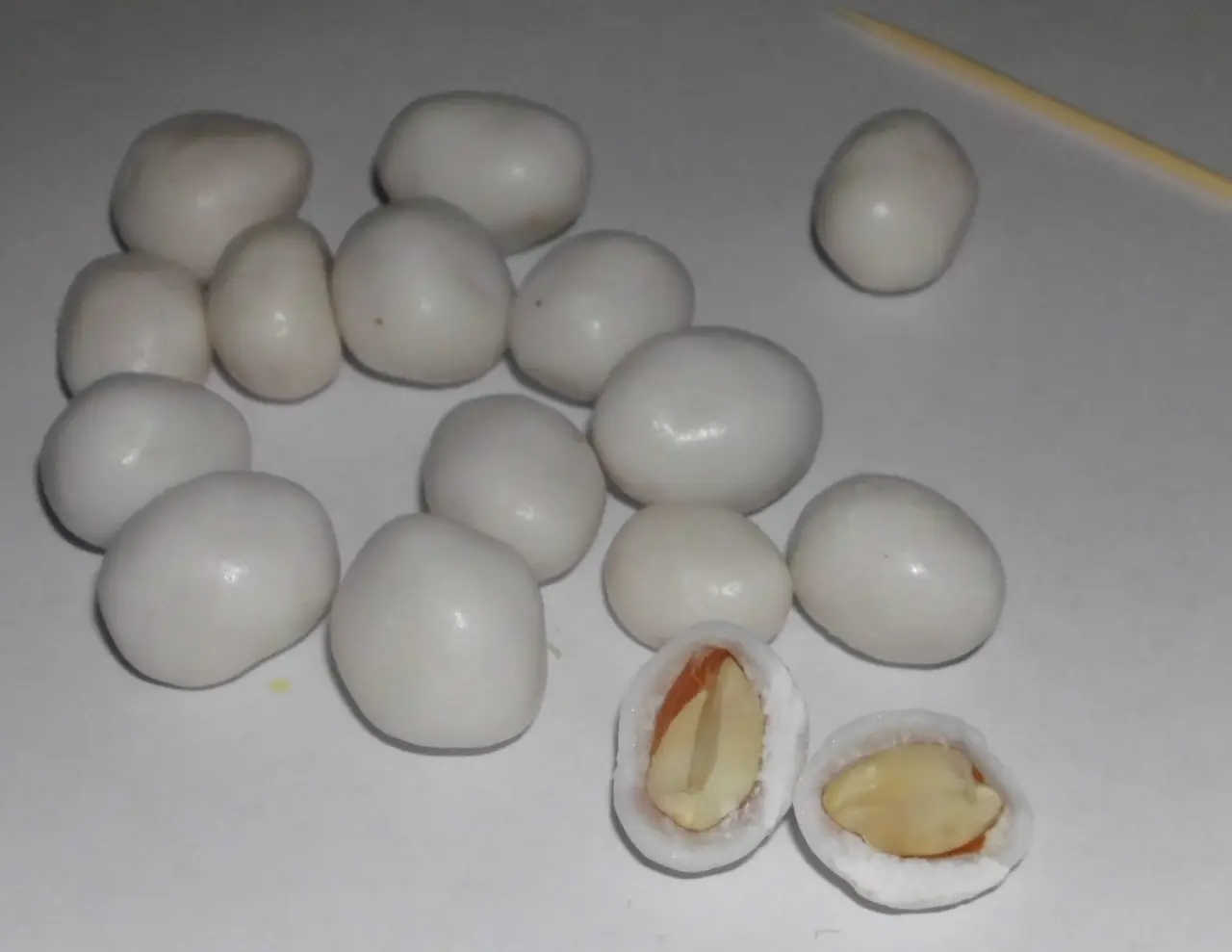
A Jordan almond is the version many North American guests recognize from celebration favors: an almond under a firm sugar coat. It is a close relative of the historical sugarplum, not a definition for every sugarplum. The familiar almond shape makes the layers easy to imagine, especially if you find a cut piece that shows the nut, the pale shell, and the clean line between them.
None of these labels needs to be a quiz. Use them as trail markers. “Comfit” points to the older family. “Dragée” points to a coated confection. “Jordan almond” points to a specific almond-centered member of the family.
Why a hard shell changes the whole bite
Panned candy is a sequence, and that sequence is why it remains fun. A soft candy gives you one main texture from the start. A coated candy asks you to cross a boundary.
First comes the surface. It may be glossy, matte, rough, or polished. Then comes the crack. That moment tells you whether the shell is thin and delicate or thick and assertive. Finally, the center answers back: nutty, spicy, chocolatey, fruity, or simply crunchy.
This structure helps explain why a chocolate-covered almond and a sugar-coated almond feel so different even when they share the same center. Chocolate softens with warmth and often yields quietly. A sugar shell stays firm longer and announces itself with a snap. One is a melt; the other is a break.
It also explains why a small sugarplum can seem louder than its size. The coating concentrates sound, texture, and sweetness at the opening. The center arrives later as a contrast. A caraway comfit could turn one tiny seed into a long, aromatic experience. A sugar-coated peanut can make a familiar snack feel formal and deliberate.
You do not need to decide that one structure is better. The useful observation is that confectioners can use a shell to choreograph a bite. The shell controls what you notice first and when the center gets a turn.
A five-minute sugarplum detective game
This is an observation activity, not a home panning project. Commercial panning requires time, heat, and control; there is no reason to turn a casual tasting into a sticky kitchen experiment. Instead, gather two or three ready-made candies that have clear contrasts.
Choose a sugar-coated nut or peanut, a chocolate-covered nut, and a hard candy. Check every package first for ingredients and allergens. Put each sample on a plate beside a glass of water. Then try this short sequence:
- Look for the center. Which candy hints at what is inside? A visible almond shape tells a different story from a perfectly round coated chocolate.
- Tap or press gently. Do not crush it. Notice whether the surface sounds hard, feels waxy, or gives slightly. You are learning what the first bite may be like.
- Take one small bite. Does the outside crack, melt, or dissolve? When does the center become noticeable?
- Name the timeline. Try a short sentence: “The shell comes first, then the nut,” or “The chocolate melts before the almond crunches.” This is the whole lesson.
The hard candy belongs in the comparison because it makes the shell idea visible. A hard candy is almost all exterior; a coated nut is exterior plus center. Both show how a firm sugar structure can slow down a sweet, but only one has a second ingredient waiting inside.
For a plain nut reference, Pearls Candy & Nuts’ nut aisle is a verified place to browse uncoated nuts alongside the candy comparison. Keep the selection small. One coated item and one plain nut are enough to make the transformation easy to taste.
Read the surface before you read the color
Color is often the first thing people notice in a panned candy, particularly around holidays and celebrations. It is tempting to make the color carry the whole meaning. But the surface tells a more useful story.
Is the coating very smooth, or can you see tiny ridges? Does it look like it was polished, dusted, or left matte? Is it thick enough to hide the center’s shape, or thin enough that the almond or peanut silhouette is still obvious? These details reveal the candy’s design more reliably than whether it is white, pink, or bright blue.
Try turning a piece in the light before you eat it. A uniform shine suggests finishing work. A rougher surface may make the bite feel more rustic or crunchy. A visible seam or uneven patch is not automatically a flaw; it can simply show the human-scale character of a small batch. What matters is whether the candy is dry, intact, and pleasant to handle.
That attention also makes a bowl of mixed sweets more generous. Instead of sorting only by color, sort by behavior: crack, melt, chew, dissolve. A plate with those four actions will feel varied even if every candy is the same color.
The long route from luxury to everyday candy
The older sugarplum was labor-intensive because its layers took time. Repeated panning made sense for special occasions because the result was durable, shareable, and visibly transformed. A seed or nut could become a small object of abundance.
Industrial machinery changed the scale of candy making, but the older idea did not disappear. The Smithsonian’s account of early candy production makes the contrast clear: panned comfits required repeated work, while machines for other candies helped speed up a growing industry. Modern candy makers can automate much of the process, but the finished experience still depends on the same old structure—center, coating, patience.
That history gives sugarplums a useful place at a contemporary gathering. You do not have to stage a period dessert table or pretend every coated candy has a medieval backstory. Simply give people one sentence of context: “These are cousins of sugarplums—a center built up with a shell.” Then invite them to notice the crack.
It is a better story than “these are tiny plums,” because it is true to the candy. It gives the guest something to do with the information. They can look for the center, listen for the break, and understand why a little white almond can feel more ceremonial than a loose handful of nuts.
A better way to think about the famous name
Sugarplums are a reminder that candy is often more mechanical than it looks. A hard shell can be a slow-made archive of many small choices: the center selected, the syrup added, the drying time allowed, the finish chosen. The final piece hides the work so neatly that it is easy to miss.
The next time you see a sugared almond, a coated peanut, or a bowl of shiny little dragees, start with the question that makes old sugarplums come alive: what is at the center? The answer might be a nut, a seed, or a surprise. The important part is that the sweetness did not arrive all at once. It was built around something worth protecting.
That is the real charm of a sugarplum. Not a fruit. Not a fairy. A tiny, crackling lesson in layers.