Fudge looks like it should be simple. It is usually cut into calm, dependable squares: a brown one, a pale maple one, perhaps a piece flecked with nuts. Pick one up, though, and it reveals a stranger ambition. Good fudge is firm enough to hold a clean edge, soft enough to yield without a snap, and smooth enough that sugar seems to disappear into creaminess.
That last part is the trick. Fudge is full of sugar crystals. In most candies, a visible or grainy crystal is trouble. In fudge, thousands of extremely small crystals are the texture. The goal is not to prevent crystallization; it is to make it happen late, quickly, and on such a tiny scale that the tongue reads the result as velvety rather than sandy.
That makes fudge a wonderful candy to taste with attention. A square is not merely sweet. It is a record of dissolved sugar, cooling, stirring, fat, flavor, and patience. This guide explains the controlled crystal traffic jam inside a good piece, gives you a practical way to compare styles, and helps you tell a creamy fudge from a merely soft one.
Creamy is a texture, not an ingredient list
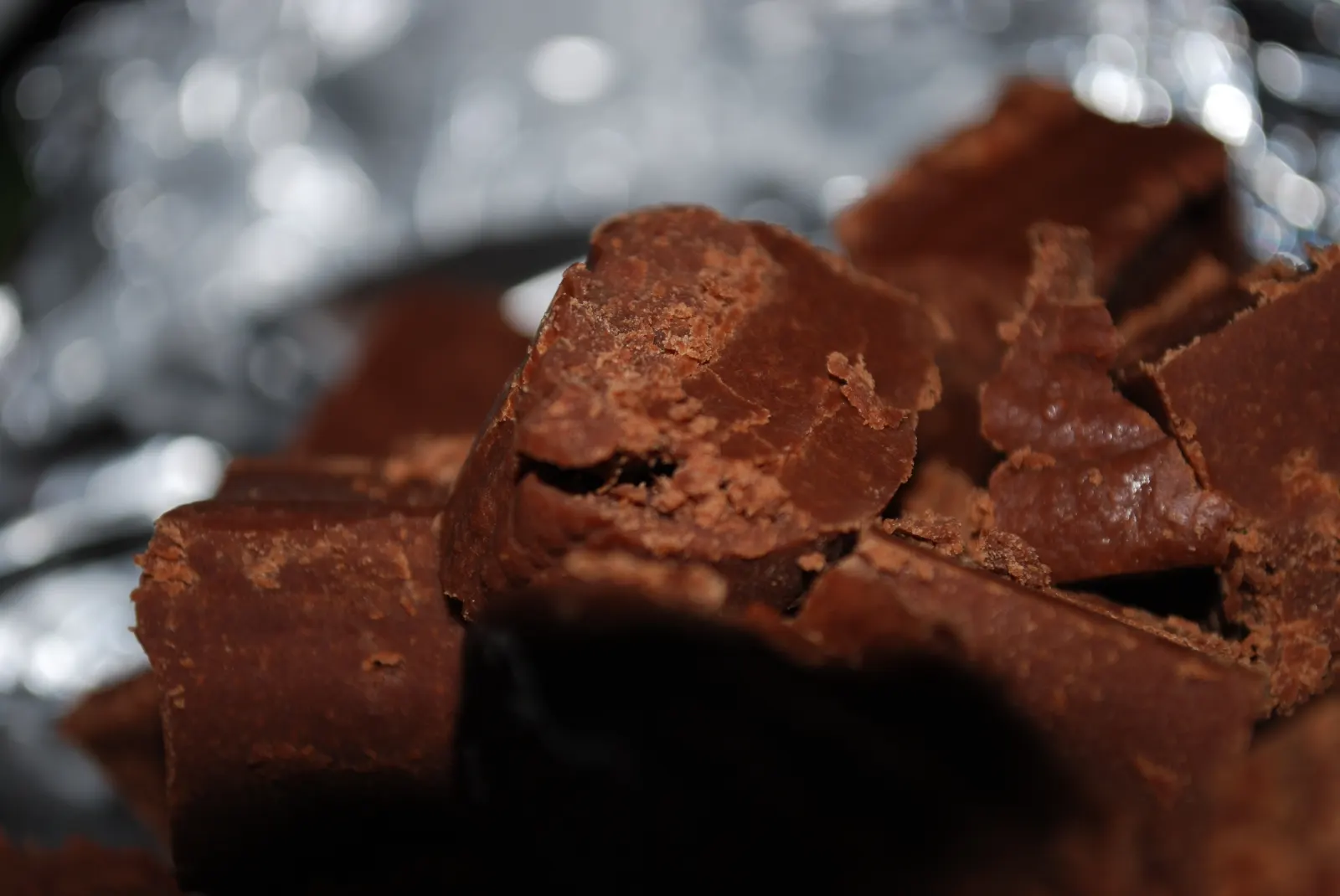
The photograph above shows chocolate fudge in rough, handmade-looking pieces. The cut edges are useful evidence. They are matte rather than glassy; the interior looks dense but not wet; and the surface has a faint, fine-grained character instead of the hard shine of a lollipop or brittle.
Those visual clues point to a different candy family. Hard candy, taffy, caramel, and brittle usually work to keep ordinary sugar crystals from forming in the final texture. Fudge and fondant do the opposite: they use crystallization, but keep the crystals extremely small. The Exploratorium’s explanation of what makes fudge special calls fudge a rare exception to the usual rule that crystals are undesirable in candy. Tiny microcrystals give it structure; large ones are what make a batch feel grainy.
This solves a common contradiction. A fudge can be both crystalline and smooth. “Crystal” does not automatically mean “crunch.” Think of beach sand versus flour. Both are collections of particles, but their scale changes the feeling completely. Fudge aims for a crowd of particles so small and so evenly distributed that they support the candy without announcing themselves one by one.
That is why the best description is often not “soft.” A marshmallow is soft. Caramel can be soft. A creamy fudge is short: it yields, breaks, and then melts away in a compact, dense bite. It feels substantial for a second, then it clears the palate more quickly than a chewy candy would.
The syrup has to become unstable first
Fudge begins with a syrup holding more dissolved sugar than would normally stay dissolved at room temperature. Candy makers call that state supersaturation. It is not magic; it is a temporary imbalance created by heat and concentration. As water leaves during cooking, more sugar can be held in the hot liquid. As the syrup cools, it carries more dissolved sugar than is comfortable at the lower temperature.
The University of Alaska Fairbanks explanation of fudge chemistry describes what happens next: a cooling syrup is ready to crystallize, but it needs places where crystals can begin. If only a few starting points appear too early, those crystals have time to grow large. Large crystals are easy for a tongue to notice, which is why a grainy fudge feels like a mistake rather than a treat.
The good version waits. A syrup that cools undisturbed can remain in its unstable, supersaturated state long enough to set up the right kind of transformation. Then, when it is stirred at the intended time, many crystal sites form at once. With so many crystals competing for the same dissolved sugar, none gets very large. The mixture thickens, dulls, and becomes the creamy, firm candy people recognize as fudge.
You do not need a saucepan to notice the effect. Look closely at a piece of fudge. A good cut face usually has a gentle matte bloom, not the wet gloss of ganache or the sharp transparency of hard candy. Press it lightly with a clean finger. It may give a little, but it should not smear like frosting. That balance is the little crystal network at work.
Timing matters more than force
Fudge has a peculiar instruction built into its science: during one part of the process, leave it alone; during another, agitation is the whole point. That reversal is why the candy can frustrate people who assume that more stirring is always safer.
K-State Research and Extension gives a concise version of the sequence in its holiday-candy guide. It identifies fudge as a crystalline candy, places the syrup at the soft-ball range of 234–240°F, and advises letting it cool before vigorous stirring creates the fine crystals that give a creamy texture. The guide’s message is useful even if you never make candy: temperature and timing are part of the ingredient list.
Early disturbance is a different thing from late beating. A grain of sugar on the wall of a pan, a scrape from the side, or premature agitation can start a few crystals forming before the syrup is ready. Once they have a head start, they can become too large. Later, stirring has the opposite role: it makes enough small starting points that growth is shared across the whole mixture.
The result gives fudge its characteristic finish. A properly crystallized piece often changes from glossy to dull as it sets. The surface is not “less good” because it lacks shine. The dullness can be a sign that the candy has moved from a smooth liquid appearance to a mass of tiny crystals.
This is also a good reason to resist calling every rough-looking fudge “homemade” or every glossy one “premium.” Appearance is a clue, not a verdict. A chocolate coating, a topping, or a particular formula can change the surface. The useful question is what happens at the bite: does the piece dissolve creamy and compactly, or does it leave individual sugar grains behind?
Fudge is not caramel wearing a square shape
Chocolate, butter, milk, vanilla, nuts, maple, peanut butter: these can all appear in a fudge shop. They matter for flavor, but they do not define the basic texture. The key distinction is whether the sugar has been organized into those tiny crystals.
Caramel and fudge may both look brown and dairy-rich, but their textures are built differently. Caramel generally aims to stay noncrystalline and chewy. Fudge deliberately recruits crystals. The Exploratorium makes the comparison directly, putting fudge and fondant in the crystalline group while placing caramels, taffy, and lollipops among candies that avoid crystal formation.
That difference changes the order of a bite. A caramel gives resistance, stretch, and a long chew. Fudge gives a brief resistance, then a soft collapse. A chocolate truffle can be even softer and more fat-forward; a brownie can be cakey or dense but has a baked crumb. Fudge belongs to its own middle ground: not liquid, not chewy, not baked, and not brittle.
This is useful when buying an assortment. If you want a slow, pull-apart treat, choose caramel. If you want a piece that makes a clean, small serving feel complete, choose fudge. If you want to taste the brown-sugar or cocoa note quickly and then move on to something else, fudge is unusually good at that job.
Chocolate is a flavor layer, not the whole structure
Chocolate fudge is the version many people picture first, but chocolate is only one way to dress the crystalline base. It brings cocoa bitterness, roasted notes, and a darker color that can make the sugar texture feel even richer. A plain vanilla or maple fudge exposes the base more directly, which is why some people find it more obviously sweet or more revealing of graininess.
Try a small comparison between two flavors rather than looking for the “best” fudge. A chocolate piece and a maple or brown-sugar piece can show different parts of the same structure.
- Chocolate often leads with cocoa and lets sweetness arrive behind it.
- Maple or penuche-style fudge can put brown sugar, butter, and toasted notes in front.
- Nut-studded fudge adds a separate crunch, so the candy’s soft crystalline break happens around firmer interruptions.
- Peanut-butter-style fudge can feel denser and more savory, but it should still avoid a sandy finish.
Start with the plainest-looking sample first. Take a small bite and let it sit for a moment. Does it melt evenly, or does the sugar appear as separate grit? Then try the bolder flavor. Notice whether cocoa or nut flavor masks the texture—or makes it more interesting. A tasting like this does not need many pieces. Two squares and a glass of water are enough.
The origin story is less certain than the chemistry
Fudge has a famous accidental-invention legend, often connected with a batch of another candy that was “fudged.” College stories involving Vassar, Smith, and Wellesley appear often too. The trouble is that those accounts do not settle into one verified beginning.
The Exploratorium’s fudge recipe notes the useful, honest version: fudge emerged in the United States around a century ago, but its exact origins are disputed, and several stories connect it to an accidental failure or to women’s colleges. That uncertainty is more interesting than a too-perfect founding tale. It matches the candy itself. Fudge depends on controlling something that is eager to behave unpredictably.
Rather than force one origin, think about why the candy became memorable. It turned a difficult sugar process into a shareable form: a pan, a slab, a tray, then small squares. A single large batch can become many modest portions without needing wrappers or machinery. That makes it naturally suited to holidays, bake sales, gift tins, and counter displays.
The story also explains why fudge varieties keep multiplying. Once the texture is understood, flavor can travel widely: chocolate, maple, peanut butter, vanilla, coffee, nuts, and seasonal spices. The flavors change the personality, but the tiny crystals give the category its recognizable voice.
A five-minute smoothness test
You do not need to make fudge to learn from it. Put one or two small pieces on a plate, along with water and a plain cracker or a few unsalted nuts for a reset. Then use this quiet sequence:
- Look at the cut face. Is it matte, glossy, crumbly, or dense? Are there visible sugar grains or only a fine-looking interior?
- Break, do not bite. A good piece may separate with a short, soft break. It should not shatter like brittle or stretch like caramel.
- Let a small piece warm. Put it on the tongue before chewing. Notice whether it begins to soften from the edges or stays stiff.
- Chew once or twice. Pay attention to the end of the bite. Smooth fudge fades creamy. Grainy fudge leaves a distinct sandy texture.
- Reset, then compare. Water or a plain cracker stops chocolate, maple, or nut flavors from overwhelming the next sample.
The point is not to reject every imperfect piece. Slight variation is part of a hand-cut confection. The point is to identify what you prefer. Some people enjoy a firmer, more crumbly square; others want a dense melt. The important distinction is between a deliberate texture and uncontrolled coarse sugar.
Grainy can mean different things
“Grainy” is often used as one broad complaint, but it helps to separate what you are feeling. A nutty fudge can have crunchy particles by design. A brown-sugar fudge may have a slightly rustic texture. A fudge that has dried at the edges may feel more crumbly than one cut fresh.
The classic failure is different: individual sugar crystals that feel large, hard, and sandy in a candy meant to be creamy. The science is not a matter of snobbery. Larger crystals change the way sweetness is released and can make the piece feel dry or harsh. The University of Alaska explanation traces this to the timing of nucleation and growth: a few early crystals get the chance to become too large.
That vocabulary lets you be specific. Instead of saying “this is bad fudge,” you can say, “I like the toasted flavor but the finish is sandy,” or, “I like the crumble but want fewer coarse crystals.” That is a much more useful way to choose a second piece—or a different flavor next time.
A small square can still be an event
Fudge has an advantage over many candies: it does not need a huge portion to make an impression. Because the texture is dense and the flavor arrives quickly, one small square can be enough for a deliberate tasting. Serve it on a plate instead of leaving it in a crowded mixed bowl. Give it room-temperature breathing space rather than treating it like a hard candy that can wait forever in any environment.
If you want to explore different styles, Pearls Candy & Nuts’ fudge aisle is a verified place to browse flavors including chocolate, maple, peanut butter, penuche, and nut combinations. Use the exact product page and package for current ingredients and allergen details; a category is a useful starting point, not a substitute for the label.
A simple pairing makes the contrast clearer. Unsweetened tea or coffee can cut through a rich chocolate piece. Plain roasted nuts make a maple or penuche-style piece seem more buttery. A tart fruit, served separately rather than piled on top, can make the confection feel less heavy. Keep the partner quiet. The goal is to notice the fudge’s own short, creamy finish.
Respect the tiny crowd
Fudge is a reminder that good candy does not always come from preventing disorder. Sometimes the right kind of disorder is the entire point. Its soft square holds thousands of tiny sugar crystals, each too small to stand out, all working together to make a firm candy feel smooth.
The next time you cut or unwrap a piece, look past the flavor name. Notice the matte face, the short break, and the way the bite moves from firm to creamy. Chocolate, maple, peanut butter, and nuts can all change the story, but the real feat is smaller: a crowd of crystals that knows how not to get in the way.