A caramel apple makes a big promise with very little equipment: one piece of crisp fruit, one coat of sticky brown candy, and a stick that turns the whole thing into a portable event. It is bright, glossy, awkward, seasonal, and much more interesting than its simple silhouette suggests.
The pleasure is a collision of opposites. An apple is cool, juicy, acidic, and quick to crunch. Caramel is warm-toned, dense, slow to chew, and made by concentrating sugar with fat and milk solids. Put them together and each makes the other more vivid. The apple keeps the caramel from becoming merely sweet; the caramel turns a familiar piece of fruit into a fairground-sized occasion.
That collision also explains why caramel apples deserve more attention than a single big bite. They have a real flavor structure, a small but useful history, several look-alike cousins, and one food-safety detail that changes how a fresh caramel apple should be handled. This is not a recipe. It is a guide to noticing what makes the classic work—and to choosing the version that fits the moment.
Start with the mismatch
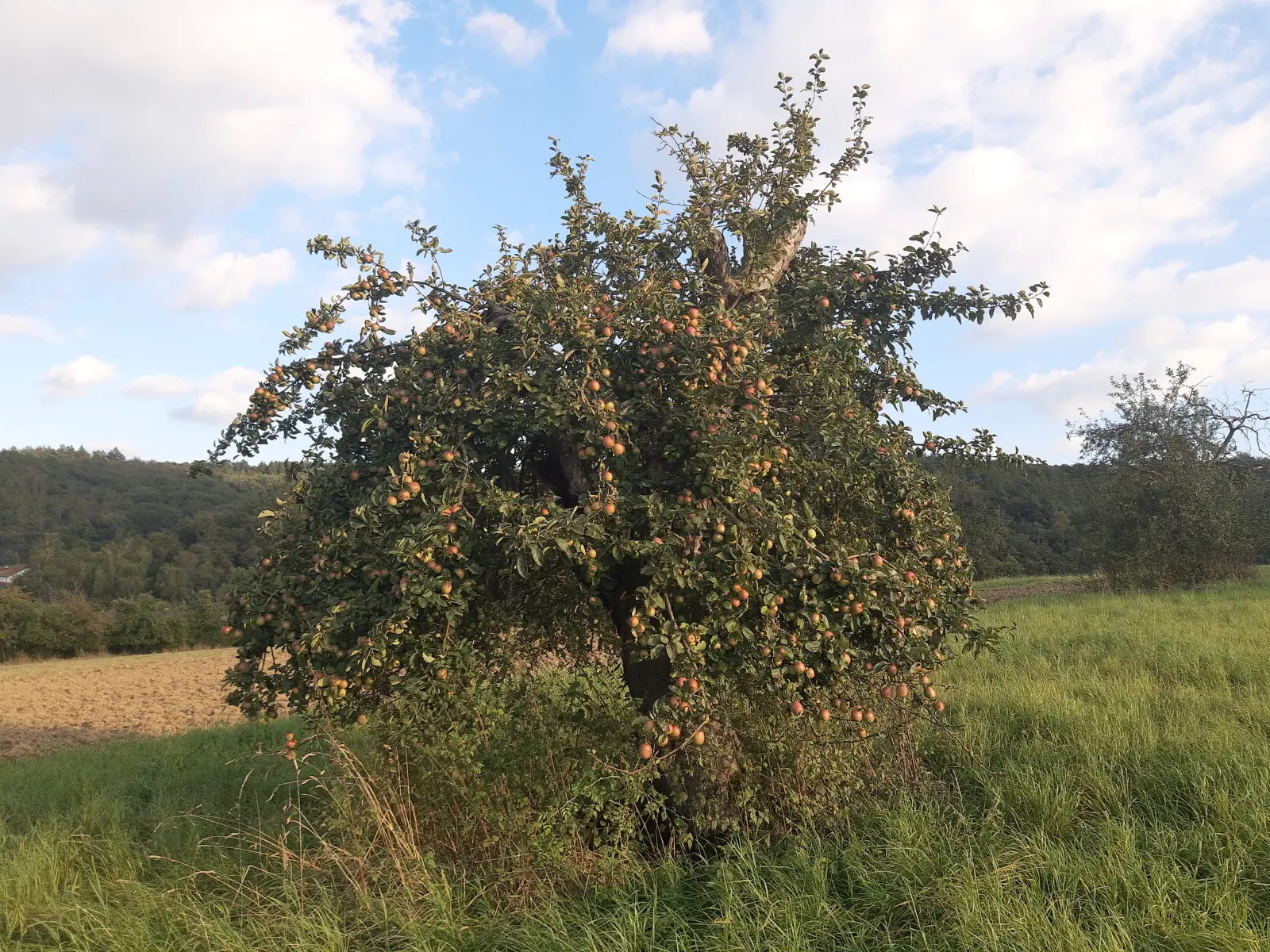
The photo above is an apple tree before the candy enters the story. It is a useful reminder that a caramel apple begins as fruit, not as a brown confection with a decorative center. The best bites preserve that fact. You should get a clean apple snap somewhere in the first chew, followed by a caramel pull that stays for a moment after the fruit has gone.
That sequence is the point. A plain apple often reads as bright and immediate. Caramel is slower: buttery, toasted, and more aromatic than plain sugar. Together they create a rhythm—crunch, resistance, release—that neither ingredient makes on its own.
This is why size matters more than it first appears. A huge apple can become a lot of fruit before the candy has time to register. A tiny apple can make the coating seem thick and dominating. There is no universal right proportion, but a good caramel apple gives both materials a turn. If the apple is fresh and firm, it keeps the experience lively. If the caramel is too soft, it may slide or smear; if it is too firm, the first bite becomes a negotiation.
The mismatch is not a defect to solve. It is the design. A caramel apple should feel a little unruly. The stick, the wrapper, the napkin, and the inevitable pause to decide where to bite are part of its charm.
Brown is not one flavor
People often call every deep-brown candy taste “caramel,” but browning has several routes. Sugar can change under heat through caramelization, while sugars and proteins can create other brown, roasted notes through the Maillard reaction. Those processes can overlap in a finished candy, which is one reason caramel has more dimension than a spoonful of sugar.
The American Chemical Society’s candy-chemistry materials make a useful distinction: a cream-and-sugar caramel cooked around 115–118°C can lean on caramelization, while commercial caramel systems with milk ingredients can draw strongly on Maillard browning. You do not need to memorize the names to taste the difference. They explain why one caramel seems buttery and mellow while another tastes toastier, milkier, or almost coffee-like.
In a caramel apple, those brown notes have a built-in counterweight. Apple acidity and aroma cut through the cooked-sugar richness. The result can seem less sweet than the same caramel eaten alone—not because the sugar disappeared, but because contrast changes attention.
Try a small, careful observation the next time you have one. Take one bite from an area with generous coating and one bite from an area where the apple is more exposed. In the first, listen for butter, cooked milk, or toasted sugar. In the second, notice whether the apple seems sharper or more floral. You are not grading the treat. You are giving both ingredients room to speak.
The candy’s history is less tidy than its shape
It is tempting to give caramel a clean origin story and then place the apple at the end of a straight line. The evidence is less obliging. The Smithsonian’s exploration of caramel history is candid that the confection has an elusive past, even while it traces specific American caramel-making traditions and the role of Milton Hershey’s Lancaster Caramel Company.
That uncertainty is worth keeping. Food history is full of stories that get repeated because they are neat, not because they are well documented. A caramel apple does not need an invented single inventor to matter. It belongs to a broad family of fruit-and-sugar ideas: preserve a seasonal harvest, make a handle for a sticky sweet, and use a tart ingredient to keep richness from going flat.
The twentieth-century fair and orchard version feels especially American, but the larger idea travels easily. Fruit plus cooked sugar can become a glossy hard shell, a chewy cloak, a sauce, a dried snack, or a flavored hard candy. The name tells you less than the texture. When someone says “caramel apple,” ask which one they mean: a whole fresh apple coated in caramel, a red hard candy shell over apple, a soft candy with apple flavor, or a packaged lollipop designed to recall both.
That one question prevents a lot of bad comparisons. A candy apple has a hard, glassy shell and a sharp crack. A caramel apple has a chewy coating and a pull. An apple-flavored hard candy may have neither fruit nor caramel but can still deliver the familiar aroma. They are cousins, not substitutes.
A crisp apple is doing serious work
The fruit in a caramel apple is not merely a handle for the coating. Its texture sets the pace. A crisp apple fractures cleanly, releasing juice and aroma. A soft one collapses, which makes the caramel feel heavier because the contrast is gone.
This is why fresh caramel apples can be so memorable at an orchard or fall gathering. They contain two clocks. The apple wants to be eaten while its crunch is lively. The caramel wants a little time at room temperature to become pleasantly yielding. The best moment sits between refrigerator-hard and countertop-slack: cool enough that the fruit tastes vivid, but not so cold that the coating feels like a jaw workout.
Surface matters too. A fruit has a smooth skin, natural waxes, and moisture; caramel is a hot, sticky coating that must settle around it. The finished product is a practical compromise, not a seamless fusion. A little slipping near a bite mark is normal. A few strands of caramel stretching from the apple are not evidence of failure. They are exactly what a chew is supposed to do.
If you are serving caramel apples, do not hide all of this under toppings immediately. Nuts, chocolate drizzle, crushed cookies, or sprinkles can be fun, but they add another texture before you have tasted the original structure. Start with one plain bite. Then notice what a topping changes. Toasted nuts add a dry, roasty crunch; chocolate makes the brown notes deeper; a salty topping sharpens the sweetness. The apple remains the reference point.
A fresh caramel apple has a real handling rule
Here is the surprising part: an apple and caramel can each look like a low-risk snack on their own, while their combination needs more care. This is not an argument against caramel apples. It is a reason to take the exact product, package, and storage instructions seriously.
The University of Minnesota Extension explains why fresh caramel-coated apples with inserted sticks received special study after outbreaks linked to commercially produced, prepackaged products. The Extension’s caramel-apple guidance describes a moister space that can form between fruit and coating, and notes that inserting a stick can move material into the apple. It also distinguishes caramel-coated apples with sticks from versions without them in its cottage-food guidance.
The practical lesson is deliberately simple. For a fresh, coated apple, follow the producer’s storage instructions, keep it refrigerated when the label or seller directs, and do not treat it like a shelf-stable hard candy. If you are buying for a group, choose from a producer with clear handling information rather than guessing from appearance. This article is not a preservation or selling guide; local requirements and product directions control those decisions.
That detail does not make the treat less festive. It actually makes its construction more interesting. A caramel apple is a tiny food-science problem disguised as a party favor. Its opposing ingredients produce the great flavor contrast and, in a fresh ready-to-eat product, create an interface worth respecting.
Meet the three caramel-apple experiences
When you want the flavor but not the full event, it helps to choose by texture instead of calling everything “the same.”
- Fresh caramel apple. This is the full contrast: juicy fruit, chewy caramel, a stick, and a napkin. It is an occasion food. Expect a large portion and follow the seller’s storage guidance.
- Hard candy apple. This version is built around a crack, a slow dissolve, and aroma. It travels easily and gives you the apple-and-caramel idea without fresh fruit or a sticky coating.
- Soft caramel or taffy-style candy. Here, the chew is the main event. Apple flavor may arrive as a bright note at the edge of a buttery or creamy center. It is less about crunch and more about a long, slow finish.
Choosing among them is not a downgrade from the classic. It is a way to match the candy to the setting. A fresh apple is great when you have a plate and a few minutes. A hard candy makes sense in a desk drawer, car cup holder, or mixed bowl. A soft chew belongs in a slower tasting where texture can take center stage.
For the hard-candy version, Pearls Candy & Nuts’ Caramel Apple Pops is a verified example to browse. The product page identifies them as hard candy. That is the useful promise here: a portable, apple-and-caramel flavor idea rather than an actual dipped fruit. Check the exact product page and package for current ingredients and allergen information.
Build a five-minute caramel-apple tasting
You can make the flavor more interesting with a very small comparison. Gather a plain apple slice, one caramel or caramel-apple hard candy, a few unsalted nuts or plain crackers, and water. The goal is not to recreate a caramel apple at home or to make a nutrition claim. It is to identify what the original combination accomplishes.
- Taste the apple alone. Is it crisp, tart, floral, or mild? Keep the description concrete.
- Taste the candy alone. Is the first impression buttery, toasted, creamy, or simply sweet? Notice whether the flavor arrives before or after the texture.
- Reset with water or a plain cracker. This prevents the lingering caramel note from doing all the talking.
- Taste the apple again. The fruit may now seem brighter because the candy has changed the baseline.
- Name the contrast. One phrase is enough: “tart after butter,” “crisp after chew,” or “fresh after toasted.”
This method is useful because it takes the treat seriously without making it solemn. It also helps explain why an apple-flavored candy can be satisfying even when it does not literally contain the fruit. The memory of caramel apple flavor is not one ingredient. It is the handoff between bright apple character and slow brown richness.
Toppings should clarify, not bury
The most successful toppings add a new contrast without making the apple impossible to eat. A dusting of chopped roasted nuts echoes the fruit’s crunch but adds toast. A little dark chocolate adds bitterness and a firmer snap. Flaky salt can make caramel seem less bluntly sweet. Cinnamon can reinforce the fall association, but it can also crowd the apple’s own aroma if applied too heavily.
There is a useful restraint test: if you cannot identify the apple after one bite, the toppings have become the point. That might be delicious, but it is no longer a caramel apple experience. It is a dessert assembled around a stick.
For a party, offer the caramel apples plain and let people add a modest topping at the table. This keeps the apple visible, makes texture choices personal, and avoids the common problem of every bite shedding a different layer. It also lets a guest who prefers the original contrast have it without negotiation.
Let the mess be part of the design
Caramel apples are not elegant in the way a square of chocolate is elegant. They demand a wrapper, a plate, and perhaps a small pause to protect a sleeve. That is not a failure of design. It is why they feel celebratory.
The treat’s lasting appeal comes from the mismatch it refuses to smooth away: fruit versus candy, snap versus pull, orchard freshness versus cooked-sugar depth. Each bite asks you to manage both. When the apple is crisp, the caramel is flavorful, and the product has been handled as directed, that small bit of disorder is exactly the fun.
The next time you meet one, take a plain first bite. Listen for the apple before the caramel takes over. Decide whether you want a hard crack, a chewy cloak, or just the flavor in a pop. A caramel apple is not one candy. It is a surprisingly good argument for contrast.