Peanut brittle gets its charm from a contradiction. It looks sturdy: a golden sheet studded with nuts, broken into substantial irregular pieces. Yet its best moment is a quick, clean fracture. It should not pull like caramel or bend like taffy. It should give way with a decisive snap, then melt from loud crunch into toasted, salty-sweet crumbs.
That snap is not an accident, and it is not supplied by the peanuts alone. Brittle starts as a hot sugar syrup that has to shed most of its water, resist turning back into grainy crystals, accept a handful of nuts without cooling too early, and often trap a rush of tiny bubbles at the very end. A minute, a few degrees, or a damp day can change the final bite.
The useful way to appreciate peanut brittle is to stop treating it as a single old-fashioned flavor and start treating it as a tiny engineered landscape: glassy sugar, scattered nuts, thin edges, and sometimes pockets of air. This is a guide to reading that landscape—at the counter, from a wrapped piece, or from a small sample shared at the table.
The sound is part of the confection
Before you taste brittle, break a small piece over a plate. A good piece makes a short, dry sound. The fracture may travel through the syrup between peanuts or go straight through a nut. Either way, the sound tells you that the sugar matrix has set hard enough to break rather than stretch.
This is why brittle belongs in a different textural family from fudge, caramel, and taffy. Those candies retain enough moisture or fat structure to yield, chew, or dissolve differently. A nut brittle is meant to be noncrystalline and crisp. The K-State Research and Extension guide to fixing peanut brittle describes the goal directly: a concentrated sugar solution plus ingredients such as corn syrup or cream of tartar that interfere with crystal formation. The target is a smooth, glass-like sheet, not a sandy sugar candy.
The point is not to judge every fragment by one perfect noise. Handmade and commercial brittles can differ in thickness, nut size, and bubble structure. Instead, listen for the general character. A clean crack suggests dry crispness. A dull bend, a sticky pull, or a chewy edge suggests that moisture has changed the piece or that it was never intended to be that thin and glassy.
The visible break is useful too. Hold a shard up to the light. The syrup portion may look clear amber, slightly cloudy, or lacy with air holes. A jagged fracture is not a flaw; irregular pieces are part of the pleasure. Brittle does not need the neat geometry of a bar. Its broken edge is a record of how the sugar set.
Hard-crack is a water story
Sugar syrup changes character as water cooks away. At first, a hot syrup is simply sweet liquid. As more water evaporates, it becomes more concentrated, then eventually cools into a solid that resists bending. The familiar phrase “hard-crack stage” names the narrow zone that candy makers use to reach this result.
The Exploratorium’s candy-stage guide puts hard crack at roughly 300–310°F and notes that the syrup forms hard, brittle threads in cold water. Its key observation is more helpful than the number alone: at this stage there is almost no water left in the syrup. That is the physical reason a candy can become a snap instead of a chew.
Numbers are useful, but they are not magic. A thermometer gives a maker a shared language; the finished candy still depends on heat distribution, pan shape, ingredients, and how quickly the syrup is poured and spread. For a taster, this is a reminder not to describe all brown sugar candy as “caramel.” Color can be similar while texture is radically different. A brittle is defined by where its syrup ended up, not merely by its amber shade.
The Alabama Cooperative Extension’s nut-brittle lesson gives another useful distinction: its process brings the syrup to 300°F after the nuts are added. In other words, the nuts are not decoration scattered onto a finished candy. They have to ride through the last, hottest phase of a texture decision. That is why a brittle can taste like a unified confection instead of a handful of nuts glued together.
A bubble can make a hard candy feel lighter
Some brittles are dense and glossy. Others look puffed, with tiny holes that make the pieces seem almost foamy. The difference often comes down to baking soda added near the end of cooking.
Alabama Extension explains the useful chemistry plainly: acids that accumulate as sugar heats can react with alkaline baking soda to release carbon dioxide. The hot sugar traps those bubbles, making the finished candy more porous and airy. That description solves a common mystery. A brittle can be hard enough to snap and still feel surprisingly light because much of the volume is air.
Try comparing a visibly bubbly shard with a dense-looking one. Do not decide that one is “better” before tasting. Start with the edge. A porous piece may shatter more readily, creating many small fragments and a quick rush of toasted flavor. A denser piece may crack into larger planes and dissolve a little more slowly. Neither effect is a trick; each is a deliberate textural style.
The bubble structure also explains why brittle can feel less aggressive than its hardness implies. The teeth are not asked to crush a solid block. They are asked to break a thin network with plenty of faults and voids. This is still a crisp candy, not a substitute for a soft treat. But it is a more intelligent kind of crispness than the name “brittle” first suggests.
The peanuts do more than fill space
Peanuts give brittle its most recognizable flavor, but their role is structural as well. Every nut interrupts the sugar sheet. It creates a change in density, a new crack path, and a toasted, savory counterpoint to the syrup. A piece with a high nut-to-sugar ratio tends to read as roasty and substantial; a more open sheet lets the amber sugar lead.
Nut size changes the experience. Whole or nearly whole peanuts make a bold, uneven bite. Halved peanuts distribute themselves more evenly and can make a thin sheet feel less lumpy. Finely chopped nuts make the candy seem more uniform, with fewer moments when one peanut takes over the bite. None of these is a universal improvement. They simply answer different questions: do you want a nut snack held together by candy, or candy interrupted by toasted nuts?
Warmth matters before the brittle ever cools. K-State advises warming or roasting nuts before adding them because cold nuts can cool the syrup too quickly and keep it from spreading thinly. That is a small practical point with a large sensory consequence. A thick, quickly setting sheet may still taste good, but it breaks differently and can feel heavier. The most graceful brittles usually invite a quick crack, not a long struggle.
If you are buying rather than making, you can use this knowledge without guessing at the recipe. Look through a clear wrapper or at an exposed edge. Are the nuts evenly distributed? Does the sheet look thin enough to fracture in layers? Is the surface dry and glassy rather than wet-looking? These are observations, not a quality scorecard, but they help you choose a piece that matches the texture you enjoy.
A small history, without pretending there is one origin story
Peanut brittle has been familiar in American home-candy culture for a long time, but one recipe cannot explain every brittle made everywhere. It is better to use specific evidence than to repeat a tidy “first invented by” tale. The Library of Congress’s holiday-candy collection points to a peanut-brittle recipe published in a 1936 newspaper and to earlier children’s candy books and household guides. That tells us something modest but useful: brittle was established enough to be presented as approachable home candy by the early twentieth century.
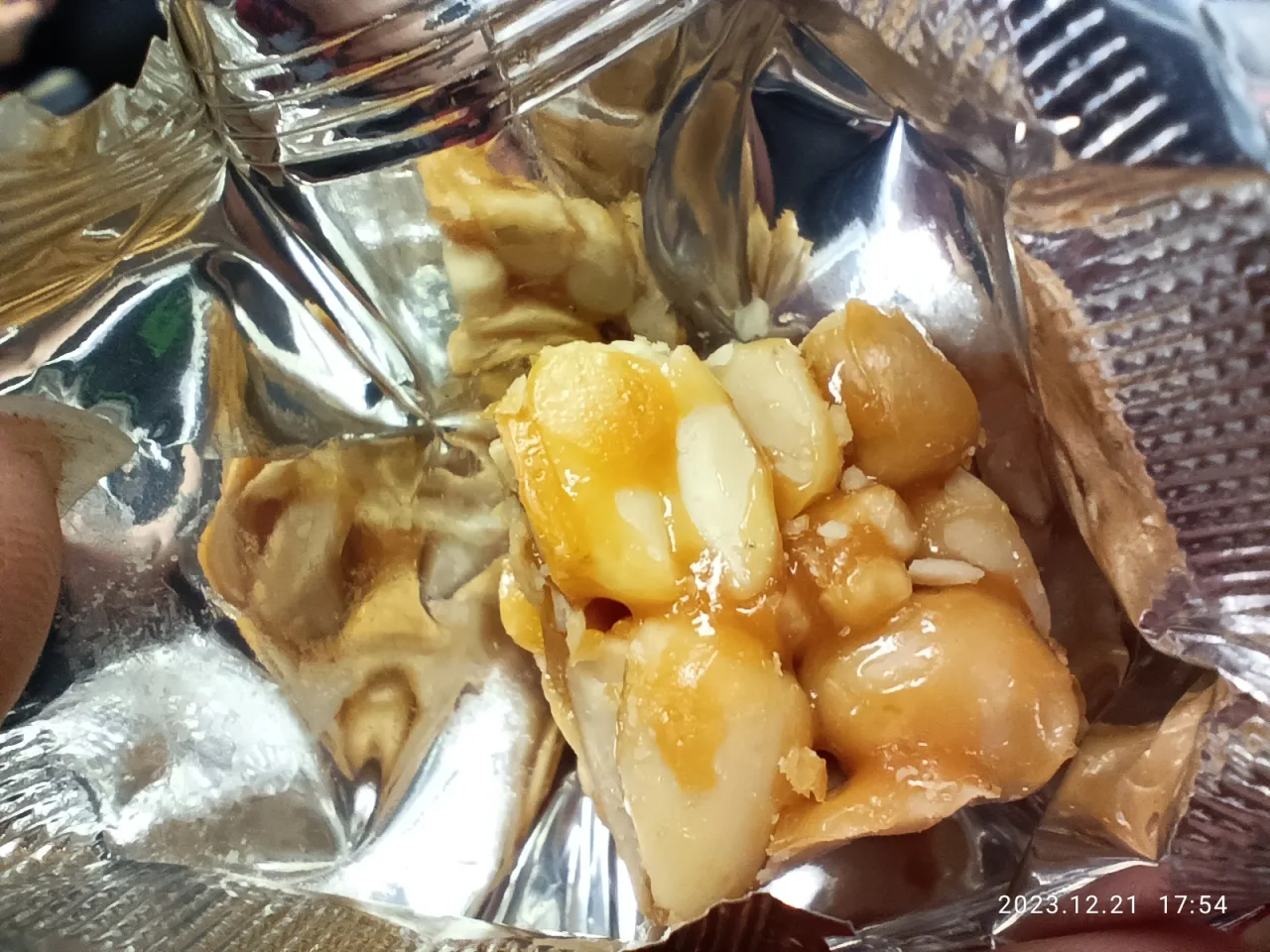
The historical descriptions are also a reminder that technique travels more easily than one exact ingredient list. Cook sugar to a high stage, include a nut or seed, spread the hot candy thinly, and break it into pieces: the result has many relatives. The photograph above shows a packaged Sichuan peanut brittle called 花生酥 (huāshēng sū) on its original source page. It is a good visual reminder that crunchy peanut-and-sugar sweets are not owned by a single American holiday tradition.
That does not mean every nut confection is the same, or that names and histories can be flattened into one category. It means “brittle” is a useful texture question. When you meet a crunchy, caramel-colored nut sweet, ask how thin it is, how the sugar is aerated, and whether the nuts are the lead flavor or a supporting note. Those questions travel better than an oversimplified origin myth.
Taste in three passes, not one big bite
Brittle rewards a small tasting method because its flavor arrives in sequence. Begin with a piece no larger than a couple of bites. This is not a contest to see how loudly it cracks.
- Look and smell. Notice the color of the syrup—pale gold, amber, or deep brown—and smell for roasted peanut, butter, salt, or a faint cooked-sugar note. A darker color often promises more caramelized flavor, but can also bring a sharper edge.
- Break, then chew slowly. Pay attention to the first fracture. Does it collapse into fine flakes, or does it divide into larger plates? Once it is in the mouth, notice when the peanut flavor appears. Sometimes sugar arrives first; sometimes the roasted nut shows up immediately.
- Pause after swallowing. The finish may be buttery, saline, toasted, or slightly bitter from deeper browning. A good finish is not always the sweetest one. Salt and roast can keep a sugary piece from feeling flat.
Water is enough for a reset. If you want a companion, choose something plain and unsweetened, such as tea or coffee, and use it as contrast rather than camouflage. Heavy desserts can make the brittle disappear. The goal is to hear the candy’s structure, not pile more sugar on top of it.
Build a useful brittle comparison from three pieces
You do not need three full bags of candy to make this interesting. Gather three small samples with a clear difference: a bubbly brittle, a dense brittle, and a nut candy that is thicker or more bar-like. Put each on a plate and make a few notes using ordinary words: thin or thick, glossy or matte, loud or quiet, peanut-forward or sugar-forward.
The useful comparison is not “which wins?” It is “what changed?” If the bubbly sample shatters sooner, the air pockets are doing work. If the dense sample stays in larger pieces, the sugar matrix may be more continuous. If the thick sample feels more like a bar, the ratio of candy to nut and the geometry of the piece have changed the experience before flavor even enters the picture.
For a source of plain roasted nuts to compare beside a brittle, Pearls Candy & Nuts’ nut aisle is a verified place to browse. A few plain peanuts beside a small brittle sample make the contrast easy to notice: roasting brings flavor, but the sugar sheet changes the timing, the aroma, and the way the bite breaks apart. Check product labels directly for ingredients and allergens; this is a texture exercise, not an assumption that every item is interchangeable.
Humidity is the quiet enemy of a clean snap
The best brittle is dry, and dry candy has an awkward relationship with a humid room. K-State notes that humidity can cause candy to attract moisture and specifically warns that moisture is a reason not to make brittles on rainy or humid days. The same basic idea helps when you are serving or storing purchased brittle: a crisp sugar matrix can become less crisp when it absorbs water from the air.
That is why an airtight container matters. It is not only a housekeeping rule. It protects the very property that made the brittle enjoyable in the first place. If a once-crisp piece begins to feel tacky, soft, or reluctant to crack, it is often telling you that its water balance has changed.
There is something pleasingly honest about this limitation. Brittle is a candy built around a moment of dryness. It cannot be asked to behave the same way forever in every climate. Serve it in small portions, close the container, and let the first crack be part of the occasion.
The point is not perfection; it is contrast
Peanut brittle can be nostalgic, but it does not need nostalgia to earn attention. It is a study in contrast: hard yet airy, sweet yet roasted, thin yet crowded with peanuts, rough-edged yet carefully controlled by temperature. Its irregular shards are evidence that sugar can become a sheet, a foam, and a crunch all in the same small confection.
The next time a piece lands in your hand, notice the fracture before you eat it. Notice whether the bubbles catch the light, whether the peanuts are whole or chopped, and whether the sweetness gives way to roast and salt. That is more than enough history and science to make a familiar candy feel newly made.