A candy cane looks so settled that it is easy to assume every part of it has always meant exactly what it means now. The hook, the red stripes, the mint, the winter display near a tree: surely they arrived together as one tidy idea. The real story is more interesting and less tidy. A candy cane is a hard-candy stick that had to be bent without breaking, decorated without losing its stripes, and made in enough quantity that people could hang, share, and eventually take it for granted.
That last detail—the bend—is the key. A straight piece of hard candy is already a technical object. It must be cooked, cooled, pulled or worked into shape, and allowed to set with its clear snap intact. Adding a hook means asking the candy to change direction during a narrow window when it is flexible enough to bend but firm enough not to slump. Make the window too short and it cracks. Make it too long and the shape distorts.
The result is a small holiday object that is also a lesson in timing. This guide leaves the invented symbolism aside and follows the more useful questions: what can we say with confidence about the candy cane, why did the hook matter, and how can you taste one as something more than a decoration?
Start by being suspicious of the perfect origin story
Candy canes attract origin stories because they look symbolic. The white is said to mean one thing, the red another, and the hook is often presented as a deliberate letter or shepherd’s crook. Some of those stories are moving. They are not, however, well-supported history.
Smithsonian Magazine’s examination of candy-cane myths makes the important point plainly: the exact origin is not known, and common claims about a specifically religious invention do not have solid evidence behind them. Straight hard-candy sticks existed in Europe long before many popular American origin tales. The famous story about a German choirmaster bending sticks for children is also difficult to prove.
That uncertainty is not a disappointment. It is an invitation to notice what the evidence does show. Candy canes grew out of an older hard-candy tradition. Their visual identity developed over time. Their commercial success depended not just on a clever shape but on reliable methods for producing that shape without wasting a great deal of candy.
When a food history has fuzzy edges, the honest version is usually the better story to share. You can say, “We do not know the first maker,” and still have plenty to talk about: the material, the bend, the stripe, and the way a small sweet became part of seasonal design.
A hook asks hard candy to do something difficult
Think first about a plain candy stick. A hard candy is meant to set into a glass-like solid. That is why it can be carried in a pocket, wrapped individually, and slowly dissolved rather than chewed. The same quality that makes it shelf-stable also makes it brittle once it has cooled.
The hook has to be formed before that final brittleness arrives. Candy makers working by hand had to shape the warm sticks quickly and consistently. The task sounds simple until you picture a long series of pieces that all need the same curve. A hook that is too tight may break; one that is too loose may not hang well; one that leans sideways looks accidental.
Time’s history of the candy cane describes the labor involved before large-scale automation: makers twisted and formed peppermint candy by hand, and the red-and-white striped, minty style did not become broadly popular until much later. The article also notes that the hook is commonly understood as a practical tree-hanging feature, even though the exact path from stick to cane is difficult to document.
That practical explanation has a satisfying simplicity. A straight candy can be eaten. A hooked candy can be eaten, displayed, and hung. The shape turned a sweet into an ornament without needing a separate string or wrapper. It gave the candy a job beyond flavor.
Stripes are not just paint
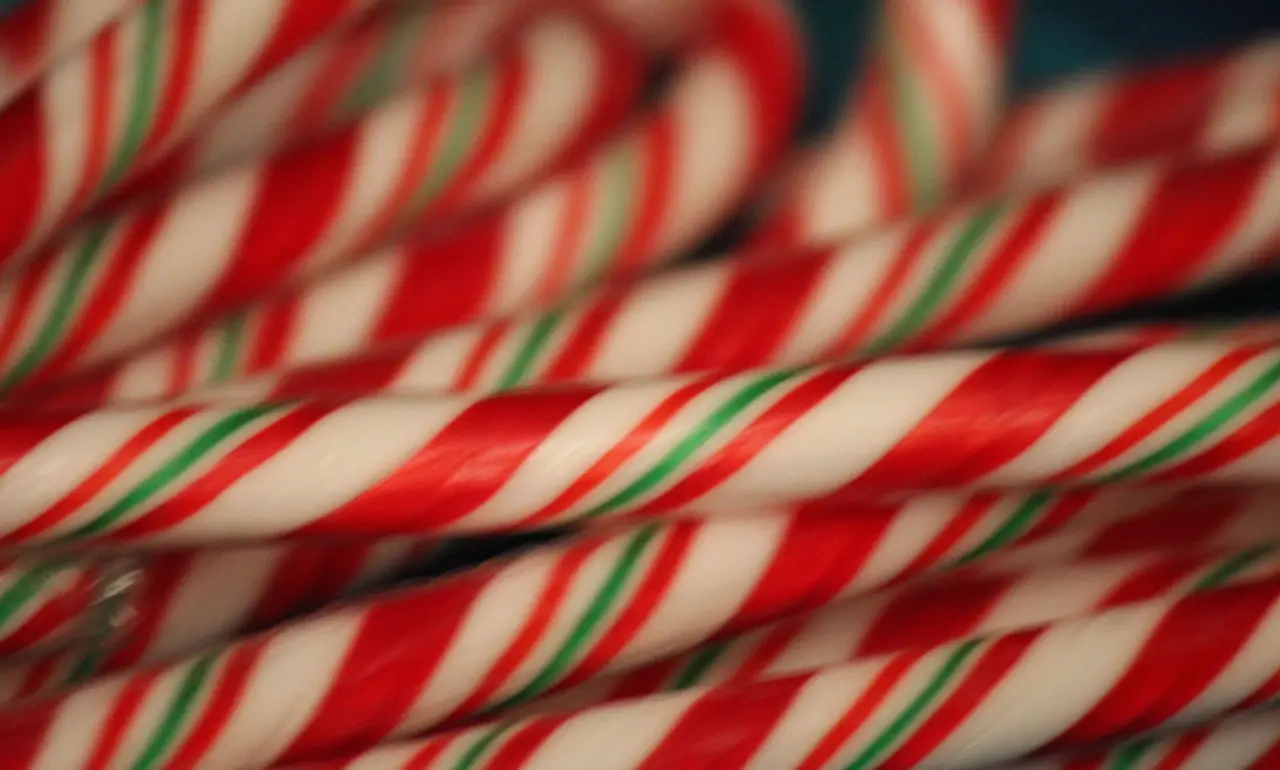
The red stripes are perhaps the candy cane’s strongest visual feature, but they are not a decoration applied after the stick has hardened. They are part of the candy’s structure. A striped cane begins with differently colored portions of candy worked together while the material is still pliable. The stripes are stretched as the candy lengthens, which is why they spiral instead of sitting in short, separate bands.
This is a useful thing to notice at the store. Look at two canes with the same basic colors. One may have broad, confident red ribbons; another may have thin, tight spirals. One may include a green detail. The pattern changes the sense of motion even before the candy is eaten. A stripe that wraps more quickly feels energetic; a broad stripe can make the cane feel more classic and calm.
The old symbolism stories often treat red and white as a fixed code. The visual history is more flexible. The Smithsonian notes that red-and-white striped canes appeared much later than the earliest candy sticks. Their popularity is part of a changing commercial and decorative tradition, not proof that every earlier stick carried the same message.
That does not make the colors less festive. It makes them more human. Someone had to decide that a plain white stick could become more vivid with a contrasting ribbon of color. Someone had to make that pattern hold together while the candy was stretched, bent, cooled, wrapped, and shipped.
Peppermint is a useful kind of contrast
Peppermint and hard candy make an unusually good pair. Hard candy takes time to dissolve, so the flavor has room to change. Peppermint begins cool and aromatic, then becomes cleaner and less sharp as the sugar melts away. It cuts through the sweetness without needing sourness or a filling.
Not every cane is peppermint, and that is part of the fun. Fruit, cinnamon, and novelty flavors show how the shape can be separated from the usual flavor expectation. But peppermint remains a strong reference point because it makes the slow dissolve feel purposeful. A minty cane does not ask you to rush. It rewards a patient pace.
Try this small comparison with two wrapped hard candies at room temperature: one peppermint cane or mint hard candy, and one fruit hard candy. Take them on separate occasions, not at the same time. Notice when the flavor seems strongest: the first minute, the middle, or the last thin layer. Then notice what remains after the candy is gone. Mint often leaves a cool aromatic trace; fruit flavors may leave a brighter, quicker memory.
This is not a flavor test with a winner. It is a way to hear what the shape and texture are doing. A chewy fruit candy would deliver its flavor in a shorter, more active burst. A hard candy lets flavor arrive over time, which is exactly why peppermint works so well here.
Why automation changed the holiday bowl
Hand-forming a hook creates an obvious bottleneck. You can cook more candy in a larger batch, but every cane still needs its curve. If many pieces break during bending, the waste can be painful. If the bends vary too much, the product loses the neat uniformity people expect from a box of candy canes.
Mechanized forming changed that calculation. The Smithsonian article recounts the story of a machine associated with Gregory Harding Keller, who was connected to the McCormack candy business in Georgia. The machine addressed a concrete factory problem: producing hooks more consistently and reducing breakage. Whether one treats every detail of that business story as a complete origin narrative or not, the manufacturing lesson is clear. A food can become far more available when a difficult hand movement becomes repeatable.
This is also why the modern candy cane feels both handmade and standardized. Its stripes suggest twisting by hand; its identical hooks suggest a system. The finished piece carries both impressions at once. It looks like a little flourish, but it behaves like a reliable unit in a package.
The broader history of candy is full of such moments. The Library of Congress’s holiday-candy collection points readers to a 1957 column on candy-cane history alongside mid-century recipes for fudge, brittle, and other sweets. The setting matters: holiday candy is not only about a particular recipe. It is about repeatable forms, storage, giftability, and the pleasure of a small seasonal signal.
Read a candy cane like a tiny piece of design
The next time you have a candy cane, pause before unwrapping it. You can learn a surprising amount without taking a bite.
- Look at the hook. Is it round, oval, narrow, or open? A tighter hook looks more compact; a wider hook looks more relaxed. Neither is automatically better. They simply have different visual rhythms.
- Follow one stripe. Trace it with your eyes from one end to the other. Does it stay even? Does it crowd at the bend? The stripe is a record of stretching and shaping.
- Check the surface. Is it glossy and clear, or slightly cloudy? A hard candy should look dry and intact. Cracks, stickiness, or dull wet spots can indicate heat or moisture exposure.
- Listen for the break. If you choose to break a cane, do it over a plate and keep pieces away from small children. The snap is the sound of the candy’s glassy structure doing its job.
That last step is optional. You can learn just as much by letting the cane dissolve. The point is attention, not destruction. The candy has already gone through several transformations; your job is only to notice the final one.
Build a candy-cane comparison without a huge haul
A good seasonal tasting needs contrast, not excess. Put three small samples on a plate: a classic mint cane, a fruit-flavored cane or hard candy, and one unstriped hard candy. Add water and a plain cracker if you want a neutral reset.
First compare shape. Which pieces could hang on a branch? Which are designed only to be held or unwrapped? Next compare surface. A striped cane invites you to look at its pattern; a plain disk puts all the attention on flavor. Finally compare time. Which one dissolves slowly enough for its flavor to change? Which one feels finished quickly?
For a broader hard-candy reference, Pearls Candy & Nuts’ hard-candy aisle is a verified place to browse other shapes and flavors that use the same slow-dissolve format. Choose one or two pieces, not a pile. The goal is to notice how much personality a confectioner can create while keeping the same basic hard-candy structure.
If you are sharing this with children, keep the explanation simple: a candy cane is a hard-candy stick with a bend, and the bend used to be tricky to make. That one sentence gives them a real piece of history without asking them to memorize a myth.
Keep the myth, if you call it a story
There is no need to scold a family tradition out of existence. If a household has a favorite symbolic reading of the candy cane, it can still be shared as a story or a reflection. The trouble begins only when a meaningful interpretation is presented as documented fact.
The distinction is generous. It leaves room for memory, faith, and seasonal imagination while preserving the evidence we have. A child can enjoy a tale about a shepherd’s staff and also learn that historians cannot confirm who first bent the candy. Those ideas do not have to compete.
In fact, the uncertain origin makes the candy more relatable. Many everyday objects become traditional through a chain of small decisions rather than a single grand invention. A straight stick becomes a hook because someone wants it to hang. A white sweet gains stripes because contrast looks lively. A difficult hand process becomes a machine process because people want fewer broken pieces. Over time, the object becomes familiar enough that we start telling stories backward from the finished shape.
The best part is still the timing
Candy canes are easy to overlook because they are everywhere in winter. They can become background: a package tucked into a stocking, a decoration on a mug, a red-and-white pattern on a store shelf. But look again and the design becomes visible.
The hook is not merely a letter or an emblem. It is a bend made at the right moment. The stripe is not merely a color code. It is candy stretched into a spiral before it sets. The mint is not merely seasonal flavor. It is a companion to a slow dissolve.
That is enough to make one cane interesting. You do not need a perfect origin myth to enjoy it. You only need a few quiet questions, a little patience, and perhaps a plate beneath the inevitable crumbs.