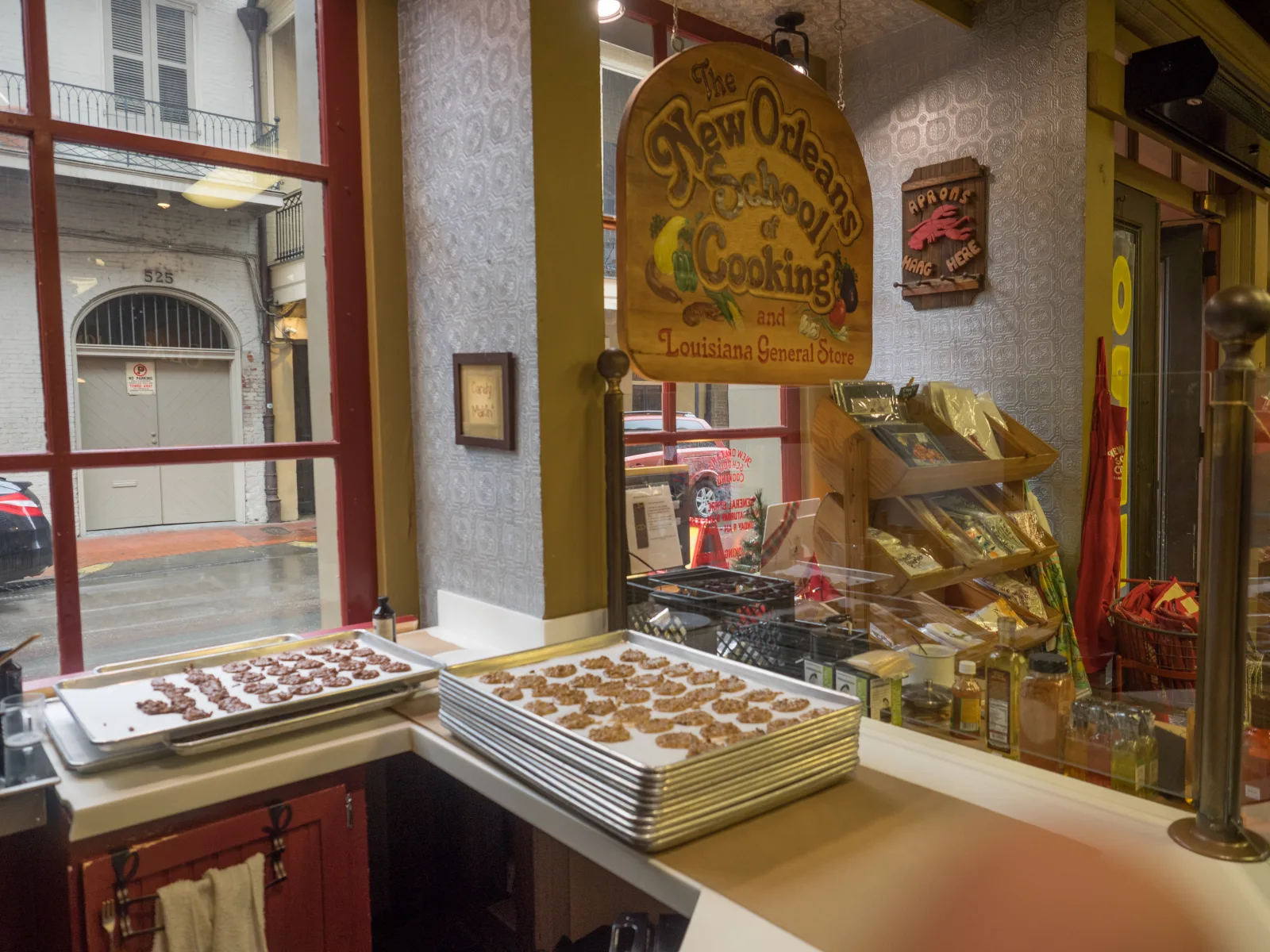
A praline can look modest: a pale, round candy with pecan pieces showing through its surface. But the word carries a much longer trip than the candy suggests. In France, a praline began as an almond confection. In New Orleans, it became a local sweet built around pecans, sugar, and a texture that breaks softly instead of crunching like a nut brittle.
That change is not a flaw in the original. It is the story. A food name can travel with people, meet different crops and markets, and become something new without losing the thread of where it came from. New Orleans pralines are a useful reminder that regional food is often made through adaptation—not by preserving every detail unchanged, but by deciding which detail matters most.
This is a guide to the pecan version’s history, the difference between a name and a single fixed recipe, and a small way to taste a praline with more attention. It is not a claim that one kind is more authentic than another. It is an invitation to notice why a French word ended up attached to a candy that feels so unmistakably New Orleans.
One word, more than one candy
The first useful fact is that praline is not a universal recipe. Across confectionery traditions, the word can point to different sweets made with nuts, sugar, chocolate, or fillings. That can make a label confusing if you expect every praline to be a small, creamy pecan disk. In New Orleans, however, the usual picture is specific: pecans held in a cooked sugar mixture and allowed to set into a tender candy.
The historical starting point was different. Oklahoma State University’s pecan history explains that French immigrants brought praline-making to Louisiana, where almonds were part of the original recipe. Almonds were scarce in colonial Louisiana; pecans were not. The available nut changed the confection’s center of gravity.
That is a stronger idea than “someone swapped ingredients.” Pecans have a large, buttery character and an irregular shape. They show up visibly in a finished candy, so the nut is not hidden inside a coating. It gives the sweet a sense of place before anyone reads the package. A New Orleans praline is a record of a local ingredient doing more than substituting for an imported one.
The same Oklahoma State source points to a 1758 Louisiana history that praised pecan pralines alongside almond ones. That early comparison matters because it shows the pecan version was not merely an emergency stand-in. Colonists were already treating it as a confection worth describing on its own terms.
A local ingredient changed the center of the recipe
Pecan pralines make sense only in a region where pecans were familiar and available. The National Park Service notes that pecan trees are native to North America and that Native people used the nuts as a food source. French colonists encountered pecans in the lower Mississippi Valley. When a French confection met a local nut, the result was not a simple handoff from one culture to another. It was a new food made within a colonial economy, with all the unequal labor and access that economy involved.
That history deserves more care than a cheerful origin story. Tulane University’s Cook Dat! exhibit places the praline within early New Orleans food history and credits Ursuline nuns with making the sweet with pecans rather than traditional almonds. The same exhibit describes French colonization and the forced transport of more than 2,000 Africans to New Orleans between 1717 and 1721. A regional candy story cannot be separated cleanly from that setting.
The material story matters, too. Sugar was not a neutral background ingredient in Louisiana. It was part of an economy shaped by plantation agriculture and enslaved labor. Pecans, sugar, cooking knowledge, domestic work, market selling, and tourism all helped make the candy’s later identity. Saying “French candy became New Orleans candy” is not wrong, but it is too small to be complete.
That is why modern scholarship on the subject is valuable. Louisiana State University Press describes its book New Orleans Pralines as a history of Black entrepreneurship, white nostalgia, and tourism as well as a history of sugar and pecans. You do not need to turn a piece of candy into a lecture to take that seriously. It simply means a souvenir can carry the work and creativity of people who were often left out of the shortest version of the story.
The recipe has lore, but the city has records
Many praline histories begin with a French nobleman, a clever cook, and almonds coated in sugar. That story is often repeated, and the name is commonly connected to César, duc de Praslin. The New Orleans City Archives’ collection of local sayings and traditions is refreshingly careful about the uncertainty: it introduces the claim with “it’s said” and then records a later account of servants learning the candy and selling it in the city.
Those cautious words are a feature, not a weakness. Food history collects legends because recipes pass through kitchens, markets, and families more often than through official paperwork. The exact moment when a pecan candy became the New Orleans praline may be difficult to pin to one inventor. What is clearer is the direction of change: a French-named confection, Louisiana pecans, and a public life in which candy could be made, sold, and carried through the city.
The City Archives also preserves an account of Zabet Philosophe, a formerly enslaved New Orleanian who sold pralines near the cathedral and Cabildo in the nineteenth century. A single historical portrait cannot stand in for every seller, but it helps correct a familiar blind spot. Pralines were not only a recipe on a fine table. They were also part of street commerce, conversation, and women’s work in public space.
That is the scale worth remembering. A praline’s history runs from a named French confection to hands that made a local version, to vendors whose businesses made the candy visible to visitors and neighbors. The word arrived first. The regional meaning was built over time.
A street sweet has to travel well
The public life of pralines helps explain their shape. A finished piece is small enough to be set on paper, passed across a counter, or carried away without a fork. Pecans remain visible, so the candy identifies itself before a customer tastes it. That is a practical advantage in a market: a sweet that looks like its key ingredient is easier to recognize and easier to remember.
The idea of a “New Orleans souvenir” can make this sound automatic, as if the candy had always been waiting for tourists. It was not. First, it had to become legible in homes and markets as a local pecan candy. The City Archives account of public sellers is useful because it puts people—not just recipes—at the center of that process. Repeated sales, conversations, and familiar places give a regional food its staying power.
When a praline travels today in a box or bag, that older portability remains part of the experience. The package may be newer than the street basket, but the gesture is related: take a piece of a city with you, then offer it to someone elsewhere. Treat that as a cultural connection, not proof that every modern seller is following one historic formula. The recipe has always had room for household and shop variation.
What makes the New Orleans version feel different
You do not need a candy thermometer to notice a praline’s character. Start with the surface. A good pecan praline often looks matte rather than glossy, with uneven nut pieces embedded in a pale or brownish sugar base. It may look almost crumbly at the edge, but it should not behave like a dry cookie.
Then notice the first bite. A brittle candy announces itself with a sharp crack. A praline is usually gentler: the sugar structure breaks, the pecan pieces offer firmer resistance, and the whole bite moves quickly toward a creamy, granular softness. The pleasure comes from contrast. The nut is recognizably itself, while the candy around it dissolves faster.
This is a useful place to separate flavor from texture. “Pecan” tells you what the nut contributes. “Buttery,” “toasty,” or “caramel-like” may describe impressions a particular piece gives you. “Sandy,” “creamy,” “snappy,” or “softly crumbling” describe structure. Keeping those observations separate makes a tasting more accurate and avoids pretending that every praline from every kitchen should feel identical.
Temperature changes the experience, too. A very cold praline can seem firmer; a piece brought to a comfortable room temperature usually opens more easily. That is an observation, not a storage rule. Follow the package for the actual item you have. The small point is that this is a candy worth slowing down for. It rewards one deliberate bite more than a distracted handful.
Three words that make a tasting clearer
The word “sweet” is true but not very informative. A praline becomes more interesting when you give separate names to the three things happening in a bite.
Nut presence is how clearly the pecan announces itself. Are there broad pieces that break distinctly, or tiny fragments that disappear into the sugar? This is not a quality score. It is a way to notice whether the nut feels like the main event or part of the background.
Candy body is the part between and around the nuts. Does it seem smooth, sandy, crumbly, creamy, or firm? Use the word that fits the actual piece. A personal observation is better than trying to match a shop’s marketing language.
Finish is what remains after the candy has dissolved. Do you notice roasted pecan first, then a cooked-sugar note? Does the sweetness fade quickly, or stay present longer? Take a sip of water before deciding. The pause keeps the last bite from overpowering the next one.
These three terms make it easier to compare two pieces without turning the exercise into a contest. They also keep the history in view. “Nut presence” is not only a texture description; in this candy, it points back to the local pecan that changed the older French template. A tasting word can be a history word when the ingredient is doing that much work.
Make a pecan-and-place tasting card
The most respectful way to turn this history into an activity is to keep it small. Choose one packaged New Orleans-style praline, if you have access to one, and a small dish of plain pecans. Check labels first: pecans are tree nuts, and anyone with an allergy should not take part. You are not trying to recreate a historic recipe. You are comparing a local nut with the candy it helped define.
Use a simple card with four lines:
- Name on the package. Does it say praline, pecan candy, or something more specific?
- Visible nut. Are the pecan pieces large, small, whole-looking, or finely broken?
- First texture. Does the candy crack, crumble, bend, or melt against the pecan?
- Place clue. What makes the candy feel tied to New Orleans: the word, the pecan, the story, or all three?
Taste the plain pecan first, then a small piece of the praline. Drink water between them. The purpose is not to judge the candy against the nut or to demand a “correct” answer. It is to notice what the cooked sugar adds and what the pecan still keeps. The comparison makes the ingredient substitution feel concrete rather than historical trivia.
If you are building the activity from scratch, Pearls Candy & Nuts’ nuts aisle is a straightforward place to choose plain pecans for the reference dish. Use the product label in front of you for ingredients and allergen information. One small bowl is enough; the history should remain the main event.
The point is the transformation
It is easy to look for the original version of a food as if history were a contest with one winner. Pralines tell a better story. The almond confection connected to France, the pecan-and-sugar candy associated with New Orleans, and other sweets that share the word all belong to a family of ideas rather than a single frozen recipe.
The New Orleans praline matters because it shows what happens when a name meets a local ingredient and a city’s complicated social history. Pecans did not merely replace almonds; they helped form a new candy. Street sellers did not merely distribute it; they made it part of the city’s public life. Later shops and souvenirs did not erase that history, even when they simplified it.
So the next time you hold a praline, notice the pecan pieces before you search for a grand origin myth. The candy’s real magic is not that it stayed French. It is that it became something more specific: a sweet, textured record of adaptation, labor, and place.