A paper cone of cotton candy looks like the least mechanical thing at a fair. It is a cloud, a wig, a tiny pink storm. It has no sharp edges, no obvious pieces, and no sensible reason to hold its shape for even a minute. Then it touches your tongue and seems to disappear before you have decided whether you are eating it or simply breathing near it.
That illusion is the point. Cotton candy is not just sugar with a new color. It is a piece of showmanship made possible by a machine: heat changes sugar, rotation flings it into fine threads, and a patient hand gathers those threads before weather and gravity have their say. Long before people settled on the name “cotton candy,” the American version was sold as Fairy Floss. That older name gets the mood exactly right. The treat looks less manufactured than summoned.
The most interesting part of the story is not a list of flavors or a contest over the biggest cone. It is the quiet engineering behind an edible thing that looks almost weightless. Once you see the spinner at the center of the bowl, the fairground cloud becomes a clever little lesson in motion, texture, names, and timing.
The cloud starts with a spinning center
The useful historical record is surprisingly plainspoken. U.S. Patent 618,428, issued on January 31, 1899 to William J. Morrison and John C. Wharton, is titled simply “Candy-Machine.” Its drawings and description center on a rotating pan or vessel. Heat softens the sugar; the moving apparatus sends it outward; and the result is a mass of “thread-like or silk-like filaments.”
That last phrase matters. The inventors did not describe a puff, foam, or spun ball. They described threads. A cotton-candy cone is a great many extremely fine threads caught in a loose bundle. The appearance of a cloud comes later, when the eye cannot easily separate the individual strands.
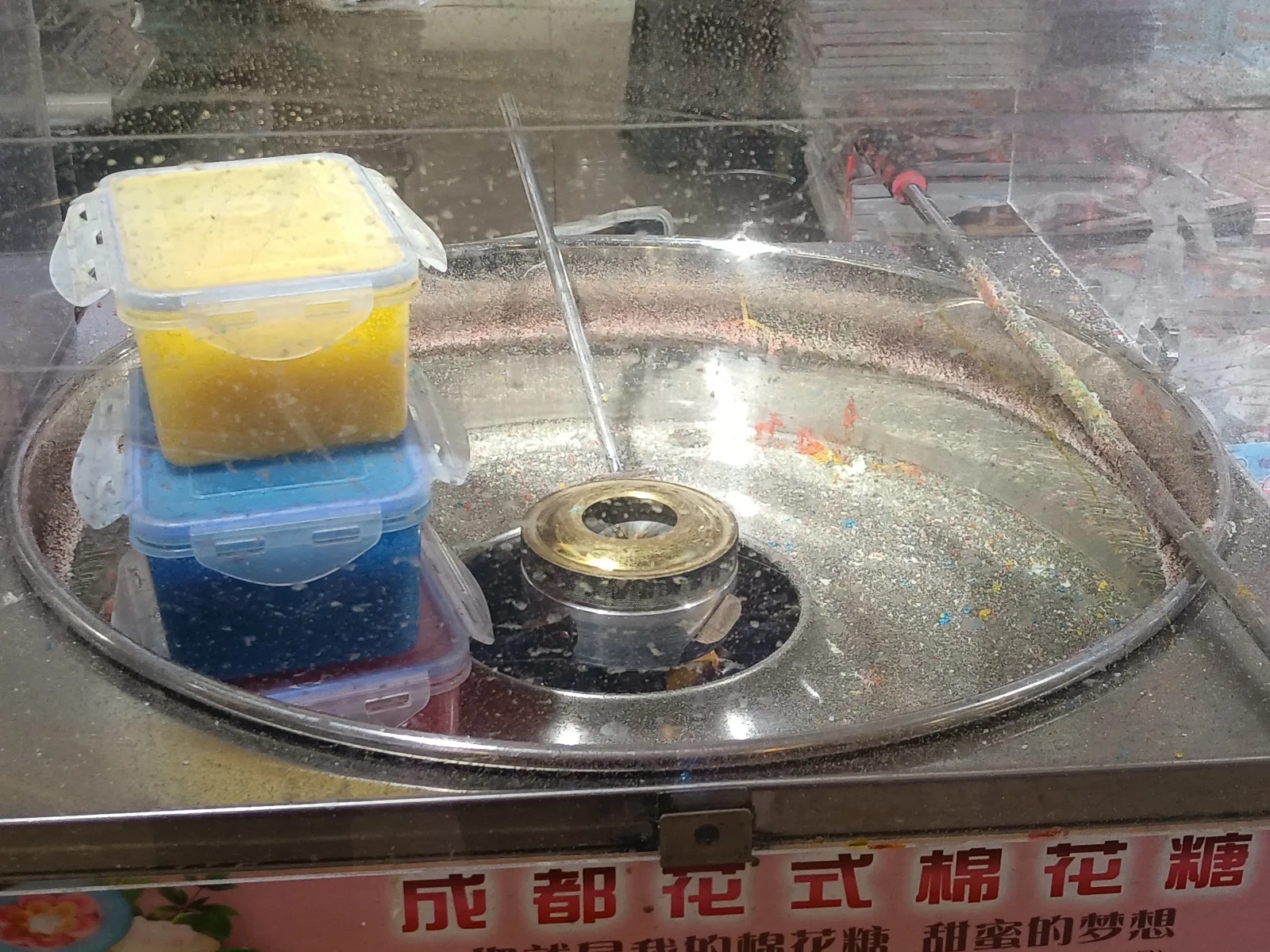
The patent also makes clear that collecting the strands was part of the design, not an accidental flourish. Its apparatus includes a surrounding surface to receive the filaments. Modern machines may have changed in materials, guards, motors, and cleaning routines, but the basic scene remains recognizable: a small spinning head inside a large bowl, a ring of fine sugar gathering along the wall, and someone winding it onto a cone.
It is worth pausing on how unusual that is for candy. Many sweets become themselves when they are cut, stamped, molded, poured, or coated. Cotton candy becomes itself while moving through space. The maker is not portioning a finished slab. The maker is catching a brief stream of threads and turning it into a shape before the threads tangle, settle, or pull apart.
That is why a machine photograph can be more revealing than a finished pink cone. In the center is a small, practical device; around it is the large basin that gives the strands somewhere to land. The cloud is a record of a process that happened seconds earlier.
Why “Fairy Floss” was such a good name
The name cotton candy makes an immediate comparison: soft fibers, pale color, a bundle that looks more textile than edible. But names for this treat travel differently. Cotton candy’s historical overview notes the names Fairy Floss, candy floss, and cotton candy, as well as the popular introduction of Morrison and Wharton’s product at the 1904 World’s Fair.
“Fairy Floss” is perhaps the most theatrical of the three. “Floss” is a word for a fine fiber. “Fairy” suggests that it arrived without effort, at a scale too delicate for ordinary kitchen work. The name does not explain centrifugal force or a heated spinner. It hides the machinery behind a better story: a confection that feels as if it has been pulled from a costume trunk or a stage cloud.
“Candy floss,” still common in several English-speaking places, puts the thread first. It sounds a little more literal. The food is sugar; the form is a soft web. “Cotton candy” reverses the emphasis. It asks you to notice a material resemblance before you taste it.
None of those names is a recipe. That is part of their strength. They tell a customer what kind of experience to expect rather than listing ingredients. A hard-candy name might suggest a flavor, a fruit, or a shape. This one sells a visual surprise: how can something so large feel so light?
The names also show why cotton candy belongs at a fair. A fair is already a place where ordinary objects are allowed to become oversized, illuminated, musical, or improbable. A paper cone full of “Fairy Floss” fits beside a carousel better than it fits beside a pantry label. Its charm depends on the small gap between what you know—this is sugar—and what you see—a soft cloud you can carry.
The 1904 fair turned a machine into an event
An invention can work perfectly and still remain a curiosity. The 1904 World’s Fair gave Fairy Floss a setting built for demonstrations, crowds, novelty, and memorable snacks. The historical overview linked above identifies that fair as the place where Morrison and Wharton introduced the product to a broad public.
Imagine the advantage of the demonstration. A customer did not have to trust a package illustration or take anyone’s word for the texture. The machine made the evidence in front of them. Sugar went into a small center. Fine strands appeared around it. A vendor gathered the strands, and a large, pale confection emerged from an amount of material that did not look large at all.
That sequence is still more persuasive than a sign. It turns buying a treat into watching a transformation. The final cone is partly a souvenir of the performance.
This is a useful way to distinguish cotton candy from sweets that are merely sold at fairs. Popcorn can be popped nearby, but the part that captures attention is the smell. Ice cream can be scooped nearby, but the visual change is modest. Cotton candy puts its most important transformation in public. The machine’s motion is the product’s opening act.
It also explains why the finished confection feels attached to a place and a moment. The cone is fragile. It does not invite you to put it away for a month, admire the wrapper, or save one piece for later. It asks to be eaten while the air is still dry enough, the threads are still distinct enough, and the fair is still happening around you.
The paper cone does more than hold it
The paper cone is easy to overlook because it is cheap, plain, and usually hidden by the candy. But it solves a real design problem. A loose bundle of threads is difficult to hand over. It has no firm base, no natural handle, and no obvious front or back. The cone gives the maker a narrow place to start winding and gives the customer something stable to hold while the cloud stays free of the hand.
That choice also changes the way we read the size of the treat. A flat bag of the same threads might look modest and fragile. Wrapped around a cone, the threads rise outward and upward. The shape borrows drama from a sail, a torch, or a bouquet. It makes the amount look generous without pretending the bundle is dense.
The cone turns a manufacturing step into a gesture. Watch a vendor closely and you can see that the hand is not cramming candy onto a stick. It is passing the paper through the forming threads, letting the bundle build in layers. A few seconds of movement make the difference between a small tuft and a cloud that can be carried through a crowd.
There is a social advantage, too. One person can hold a cone while another tears off a small piece. That is not the neatest way to share a dessert, but it is part of cotton candy’s character. The portions are irregular. The first piece may be a delicate strand; the next may be a larger wisp. The snack quietly asks people to slow down, look at it, and laugh when an ambitious bite collapses faster than expected.
A sweet that makes space visible
Most foods teach us to estimate quantity by weight, thickness, or the size of a container. Cotton candy disrupts all three. The cone looks big because the strands occupy a large volume. It feels light because there is abundant air between them. It vanishes quickly because the pieces are so thin. That mismatch is not a gimmick added at the end; it is the central pleasure of the design.
Seeing that mismatch can make a fairground purchase more satisfying. You are not just buying sweetness in a new color. You are buying a demonstration of scale. A modest amount of sugar has been stretched into a shape that your eyes interpret as lavish, soft, and almost too large to finish. The machine does not create a different ingredient. It creates a different relationship between ingredient and space.
What makes the texture seem to vanish
The visual trick and the eating trick are related. The patent’s “thread-like” filaments create an enormous amount of visible surface compared with a single hard-candy disk of the same sugar. That is an inference you can make simply by comparing one solid piece with a loose mass of fine strands: the cotton-candy bundle contains many exposed edges and gaps instead of one smooth exterior.
The result feels light because the cone is mostly space. The strands are real, but they do not form a dense block. Your hand supports a generous-looking bundle without the weight you expect from an equally large-looking brownie, caramel, or handful of jelly beans. Your mouth then meets very thin sugar strands rather than a substantial piece that must be bitten and chewed.
That distinction is a good reminder that texture is not a decoration added after candy is made. Texture is the event. The American Chemical Society’s guide to the sweet science of candy making explains how sugar’s behavior and structure make different kinds of candy possible. Cotton candy takes that broader lesson to an extreme: change the physical form dramatically enough, and familiar sugar gives a completely different eating experience.
The same thinness that makes cotton candy delightful makes it vulnerable. Moist air is not a friendly audience. The strands can lose their crisp separation, pull together, and become sticky. A cone that was airy at the counter can look tired after a slow walk through humid weather. That is not a failure of the confection. It is part of its design. Cotton candy is less like a permanent object than a brief condition of sugar.
This is also why color can be so effective. In a solid candy, color may be buried in the center or seen only on a glossy surface. In cotton candy, color runs through thousands of fine lines. The eye blends those lines into a glow. Pale pink, blue, or purple can look much larger and softer than the actual amount of color suggests.
A small way to watch the trick at a fair
Cotton candy is better when it gives you something to notice. The next time you see it being made, turn the wait into a three-minute observation game. You do not need to touch the equipment or make any of it yourself; hot, rotating food equipment belongs to the trained operator. Just watch the sequence.
Try these prompts with a child, a friend, or your own curious brain:
- Find the beginning. Where is the small spinning center, and where do the first visible strands collect?
- Follow one thread. Pick a short moment and watch the direction the maker’s hand travels around the bowl. The cone is built by gathering, not by scooping.
- Compare the shapes. Is the cone wound into a round cloud, pulled into a tall tower, or made deliberately uneven? Which shape looks largest?
- Notice the color at two distances. Up close, the color belongs to separate threads. A few feet away, those threads blend into one soft mass.
- Listen for the change. Does the vendor wait until a ring has formed before lifting it? A little patience changes loose strands into something that can travel.
This turns an ordinary fair purchase into a miniature design lesson. The answer to “How did that become so big?” is not that the machine made more sugar. It is that the machine arranged sugar in a way that makes space visible.
You can make a second, quieter comparison after the cone is gone. Choose one contrasting sweet from Pearls Candy & Nuts’ novelty-candy aisle and ask what gives it its personality: a shell, a chew, a fizz, a powder, a filling, or a familiar shape. The point is not to hunt for another version of cotton candy. It is to notice how many ways confectionery can change a small amount of sweetness into an experience with a beginning, middle, and end.
Why the machine still deserves top billing
It is easy to remember cotton candy as a color, a flavor, or a childhood photo. Those are real parts of its appeal. But the machine deserves the credit for the larger illusion. It gave sugar a new scale. It made individual threads visible as a cloud. It turned the act of making candy into something a crowd could watch and understand without a technical manual.
The 1899 patent does not read like a fairy tale. It reads like an inventor’s attempt to specify parts, motion, heat, and collection. Yet the outcome is exactly the sort of thing a fairy-tale name can carry: something ordinary transformed into silk-like filaments, gathered into a cloud, and gone before the ride lights switch off.
That may be the best reason to order a cone when you see one. Not because cotton candy needs a grand backstory to taste sweet, but because its backstory is still happening in plain view. The spinner turns. The strands arrive. A simple machine makes a temporary miracle. And for a few minutes, “Fairy Floss” is the most accurate name in the world.